Serralunga d'Alba
The most intact castle in the Langhe, Fontanafredda, and the Barolo that ages longest.
A 14th-century keep
Built by the Falletti between 1340 and 1357, state-owned today: narrow, very tall, almost untouched.
Vigna Rionda and Francia
Helvetian soils here make the hardest young and longest-lived Barolo of the whole appellation.
Fontanafredda, just below
The estate created in 1878 for the son of King Vittorio Emanuele II, with its hamlet and old cellars.
You can only arrive by car
No station, no useful bus: it is an hour and a quarter from Turin airport, door to door.
Five hundred people and a skyline you recognise for miles
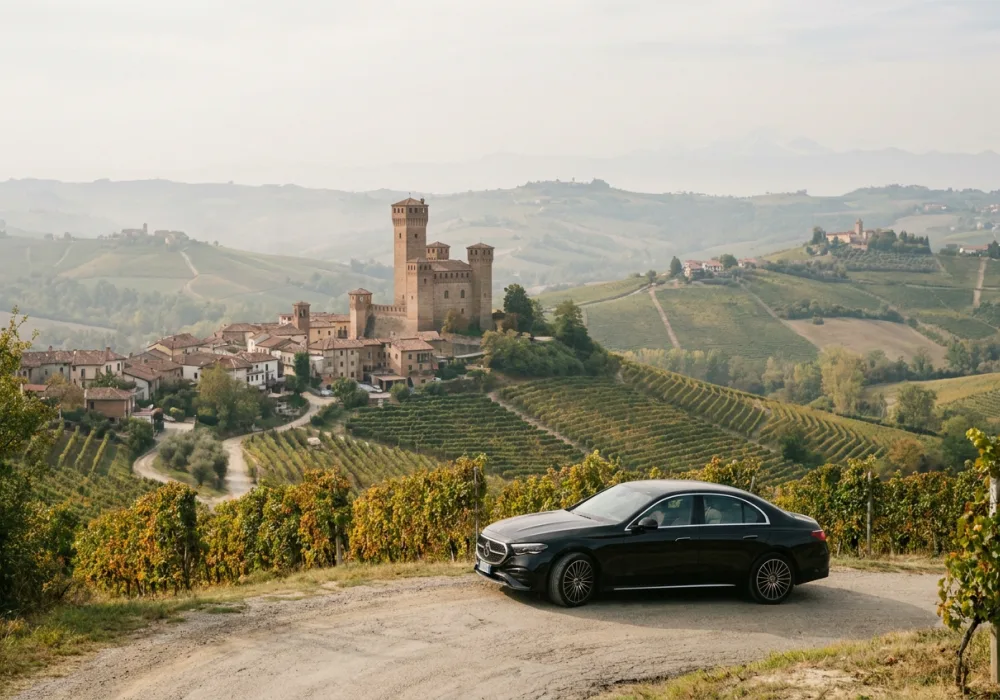
Serralunga sits on a thin ridge between the Talloria and Sinio valleys, and its castle is visible from half the Langhe: a vertical keep, built by the Falletti between 1340 and 1357, with mullioned windows, Ghibelline battlements and hanging arches. It is not the usual fortress enlarged over centuries, it is a military building left as it was. Inside, in the vassals' hall, there are 15th-century frescoes of the martyrdom of Saint Catherine of Alexandria. Since 1949 it has belonged to the Italian state, which bought it from the Opera Pia Barolo, the institution created under the will of the Marchesa Giulia di Barolo, last heir of the Falletti.
Below the village, in a hollow, lies the hamlet of Fontanafredda: the estate King Vittorio Emanuele II bought in 1858, which in 1878 became the winery of his son Emanuele di Mirafiori, born to Rosa Vercellana. Yellow-and-red striped houses, historic cellars and woodland all around.
Why growers always bring it up
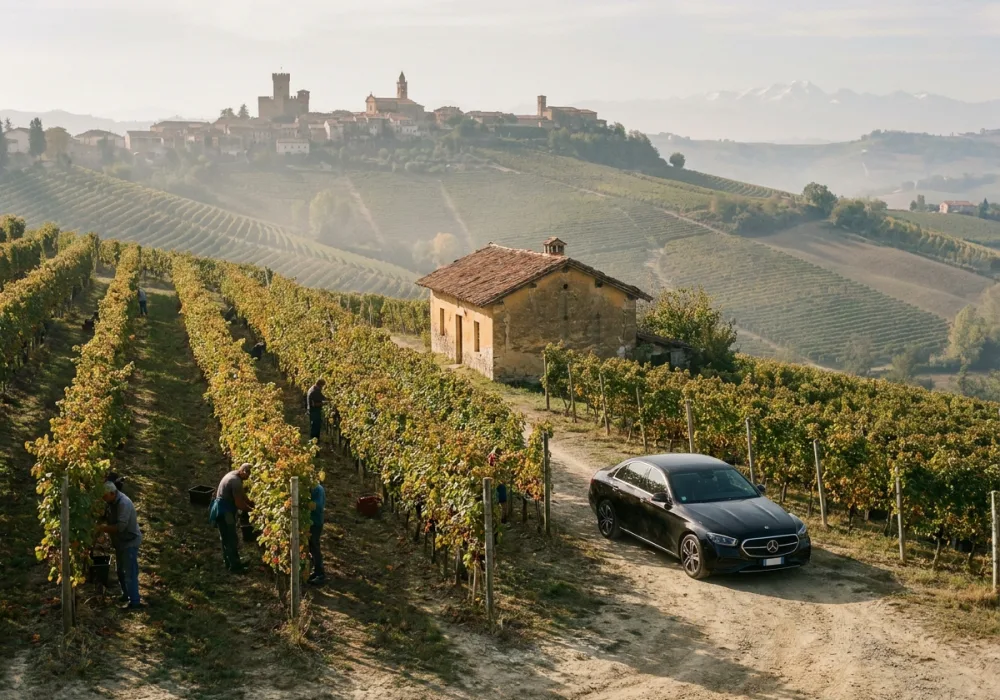
Serralunga is one of the eleven Barolo villages, but it is the one producers name when they want to explain what longevity means. The soils are Helvetian, older and poorer than the Tortonian ones of La Morra and Barolo: they give tight, tannic wines, closed when young, that then stand up for decades. The names you will hear are Vigna Rionda, Francia, Lazzarito, Ornato and Falletto.
To see it properly you want a day that takes in both sides of the valley: Serralunga or Monforte in the morning, La Morra or Barolo in the afternoon, so the difference between the soils happens in the glass instead of on a map.
Getting to Serralunga
Serralunga d'Alba has no railway station, and the buses that pass along the valley floor do not climb to the village on any timetable useful to a visitor. In practice you arrive by car: your own, a hire car, or ours.
From Turin Caselle airport
About an hour and a quarter. Our private transfer goes right into the village or to the door of your farmhouse, even when the last stretch is an unsurfaced climb.
From Turin city
A little over an hour, seventy kilometres of motorway and then the hills.
From Milan and its airports
Two to two and a half hours. By train you have to reach Alba with a change at Asti, and then still find a lift for the final ten kilometres.
From Alba
Barely a quarter of an hour. People staying in Alba who want a day across Serralunga, Monforte and Castiglione almost always do it with a driver, because on a day among the cellars the drive home is the problem.
Prices and availability are in the form above; for a tailor-made day among the villages, write to us.
We drive you up to the ridge
Private transfers from the airports and cities, or a full day across Serralunga, Monforte and Castiglione.